Basic Approach
Toward the realization of a sustainable society, we recognize that the conservation and sustainable use of natural capital—the diverse benefits provided by nature, such as biodiversity, water resources, soil, and air—are essential for the long-term growth and value creation of any company.
We consider impacts on ecosystems and water environments are particularly critical risks and opportunities to the management of Kanto Denka Kogyo because chemical manufacturing is our core business. Thus, we position them as key issues on par with climate change.
We address these external environmental issues as part of our ESG management under the same governance system and risk management processes as other material issues and keep enhancing measures through regular reviews and decision-making by management bodies and other organizations.
Response to Climate Change: Disclosures Based on the TCFD’s Recommendations
Analysis of relationship between our business and natural capital
We have been implementing analysis and disclosure of the relationship between climate change and our business activities. Similarly, we have begun systematically identifying and assessing the relationship between natural capital and our business activities, which we regard as a key material issue.
As an initiative based on the recommendations of the Task Force on Nature-related Financial Disclosures (TNFD)1, an international framework for disclosures related to natural capital, we are conducting analysis in accordance with the LEAP approach2, a method recommended by the framework. As part of our initiatives in FY2024, the results of the analysis of Locate (identification of interface with nature ) and Evaluate (dependencies and impacts on nature) among the steps of the LEAP approach are disclosed.
For other two steps, Assess (nature-related risks and opportunities) and Prepare (response and disclosure), we will further work on preparation for disclosure, including investigation and analysis of the current status.
- 1 TNFD (Taskforce on Nature-related Financial Disclosures): An initiative that creates a framework for nature-related disclosures for companies and financial institutions.
- 2 LEAP approach: An integrated approach to assessing nature-related issues, including interface with nature, dependencies and impact on nature, and risks and opportunities.
Analysis based on the LEAP approach
Dependencies and impacts related to natural capital
We first analyzed dependencies and impacts regarding the relationship between the value chains of our business and natural capital using ENCORE3, and created a heat map.
As a result, we found that “dependencies” on ecosystem services (functions such as water resources and climate stabilization provided by natural capital) are relatively high, especially in the upstream value chain, for water supply, water purification, water quality control, global climate adjustment, flood mitigation, and rainfall pattern adjustment. The results also showed that direct operations and downstream of the value chains are relatively less dependent on ecosystem services.
- 3 ENCORE (Exploring Natural Capital Opportunities, Risks and Exposure): A tool to assess the dependencies and impacts of each business sector and production process on natural capital. It was led by the Natural Capital Finance Alliance and developed in collaboration among the United Nations Environment Programme (UNEP), the World Conservation Monitoring Centre (WCMC), and other organizations.
Heat map (dependencies)
| Dependencies | ||||||||||||||||
|---|---|---|---|---|---|---|---|---|---|---|---|---|---|---|---|---|
| Supply | Adjustment | |||||||||||||||
| Water supply | Water purification | Air purification | Water quality adjustment | Solid waste purification | Other adjustments(dilution effects) | Noise reduction | Other adjustments(reduction of perceptual impact) | Prevention of soil and sediment loss | Global climate adjustment | Local climate adjustment | Flood mitigation | Storm mitigation | Rainfall pattern adjustment | |||
| Upstream | Raw material procurement/ processing | Crude oil and natural gas | M | H | VL | M | L | M | VL | L | M | H | L | H | M | - |
| Minerals | H | VH | M | H | L | M | VL | L | M | H | L | H | M | VH | ||
| Electricity | Thermal power plants | H | M | VL | H | M | - | VL | - | M | M | L | M | L | VL | |
| Solar power plant | M | - | - | M | - | - | VL | - | M | VH | M | M | M | - | ||
| Direct operation | Manufacturing of soda and fluorine chemicals, etc. | M | M | VL | M | L | L | VL | VL | M | VL | L | M | M | VL | |
| Downstream | Semiconductor manufacturing | M | M | VL | M | L | L | VL | VL | L | VL | L | M | M | VL | |
| Battery and storage battery manufacturing | M | M | VL | M | L | L | VL | VL | L | VL | L | M | M | M | ||
| Manufacturing of basic chemicals | M | M | VL | M | L | L | VL | VL | M | VL | L | M | M | VL | ||
- VHVery High
- HHigh
- MMedium
- LLow
- VLVery Low
Concerning the “impacts” on ecosystem services, we found that use of freshwater and sea areas, extraction of other abiotic resources, greenhouse gas emissions, air pollution, discharge of harmful pollutants into water and soil, generation and discharge of solid waste, and disturbances (noise and light) have particularly significant impacts on the procurement and processing of raw materials and electricity (power generation) upstream of the value chain.
We also found that the impacts of hazardous pollutants on water and soil emissions and disturbances (noise and light) are significant in direct operations and downstream of the value chain.
Heat map (impacts)
| Impacts | ||||||||||||||
|---|---|---|---|---|---|---|---|---|---|---|---|---|---|---|
| Land use | Resource extraction | Climate change | Pollution | Disturbance | ||||||||||
| Use of land area | Use of freshwater area | Use of sea area | Water use | Extraction of other abiotic resources | GHG emissions | Air pollution | Discharge of harmful pollutants into water and soil | Discharge of nutrient pollutants into water and soil | Solid waste generation and discharge | Disturbance(noise and light) | Invasion of invasive species | |||
| Upstream | Raw material procurement/ processing | Crude oil and natural gas | L | VH | VH | M | - | H | H | VH | - | M | VH | L |
| Minerals | M | VH | VH | M | H | M | H | VH | M | H | VH | L | ||
| Electricity | Thermal power plants | M | M | - | M | - | VH | VH | VH | - | H | VH | - | |
| Solar power plant | L | - | - | L | - | - | - | L | - | VL | VL | - | ||
| Direct operation | Manufacturing of soda and fluorine chemicals, etc. | L | - | - | M | - | M | M | VH | - | M | VH | - | |
| Downstream | Semiconductor manufacturing | L | - | - | L | - | VL | L | H | - | L | M | - | |
| Battery and storage battery manufacturing | L | - | - | L | - | VL | L | H | - | L | M | - | ||
| Manufacturing of basic chemicals | L | - | - | M | - | M | M | VH | - | M | VH | - | ||
- VHVery High
- HHigh
- MMedium
- LLow
- VLVery Low
The results of ENCORE analysis are general assessment based on industry-representative values. We have been taking appropriate measures to address the “discharge of hazardous pollutants into water and soil,” which is evaluated as “very high (VH)” in our direct operations. Specifically, under a monitoring system by a dedicated organization that integrates ESG (environment, safety, and governance), we conduct continuous investment in promotion of energy conservation and reduction of hazardous substance emissions, while regularly reviewing our initiatives. From the perspective of legal compliance and ensuring transparency, we continue to fulfill our obligation to measure wastewater concentration based on the Water Pollution Prevention Act and local ordinances. As a result, no violations or accidents have been identified for more than 10 years. We will continue working to prevent actualization of the risks through these initiatives and to minimize their impacts.
Reduction of Pollutant Emissions and Effective Use of Resources
Although electricity consumption is positioned in upstream of the value chain due to the nature of ENCORE, we ourselves consume a large amount of electricity mainly in the electrolysis process. We have long recognized the impact of GHG emissions (our Scope 2 emissions) generated during the power generation on climate change as an important issue closely related to our business, and therefore we take necessary measures.
Specifically, we are considering the use of renewable energy, which has a lower environmental impact than thermal power generation. In FY2023, we installed solar power generation equipment at our main plants (Shibukawa Plant and Mizushima Plant). We are also working on procurement of electricity with non-fossil certificates. We will keep promoting the creation and use of renewable energy to reduce our impacts on nature.
Response to Climate Change: Disclosures Based on the TCFD’s Recommendations
The results of the recent ENCORE analysis pointed out that some factors along our value chain (excluding direct operation) have “very high (VH)” dependences and impacts (e.g., “use of freshwater and sea areas” in the procurement and processing of raw materials upstream of the value chain). For these factors, we identify applicable business sites and evaluate their performances. With other means, we are examining measures for better understand the actual conditions of our value chains.
Identification of interface with nature
Next, to find the points of interface between our business sites and nature and to identify areas and sites that we should prioritize, we evaluated all of the manufacturing sites of the Group using various tools4 recommended by TNFD. We evaluated the regions and sites for five items: (1) conservation importance, (2) ecosystem integrity, (3) rapid ecosystem degradation, (4) water stress5, and (5) indigenous peoples and local communities.
Adding the financial importance to our business to consideration, we identified three locations as priority areas: Shibukawa Plant, Mizushima Plant, and Kanto Denka Fine Products Korea Co., Ltd.
We plan to conduct more detailed investigations and analyses, including on-site hearings, on the status of dependence and impact on natural capital in the identified priority areas.
- 4 IBAT, Resource Watch, WWF Biodiversity Risk Filter, Aqueduct, and Land Mark
- 5 This is an indicator that shows the degree to which demand exceeds supply for limited water resources. It is generally expressed as "annual total water withdrawal ÷ renewable water resources," and a higher ratio indicates greater water stress.
Assessment of Priority Areas
| Priority area | Assessment indicators | ||||
|---|---|---|---|---|---|
| Conservation importance | Ecosystem integrity | Rapid ecosystem degradation | Water stress | Indigenous peoples and local communities | |
| Shibukawa Plant | Far from Category I to IV6protected areas | Not an area with high ecosystem integrity | Areas with moderate ecological degradation | Areas with moderate water stress | Adjacency to areas managed by indigenous peoples or local communities has not been identified |
| Mizushima Plant | Close to Category IV protected areas | Areas with low water stress | |||
| Kanto Denka Fine Products Korea | Areas where ecosystem degradation is at risk | Areas with high water stress | |||
- 6 Among the protected areas (Categories I to VII) classified by the International Union for Conservation of Nature (IUCN), Categories I to IV refer to strict nature reserves and wilderness areas (Category I), national parks (Category II), natural monuments (Category III), and habitat/species management areas (Category IV).
Initiatives by Plants in Japan
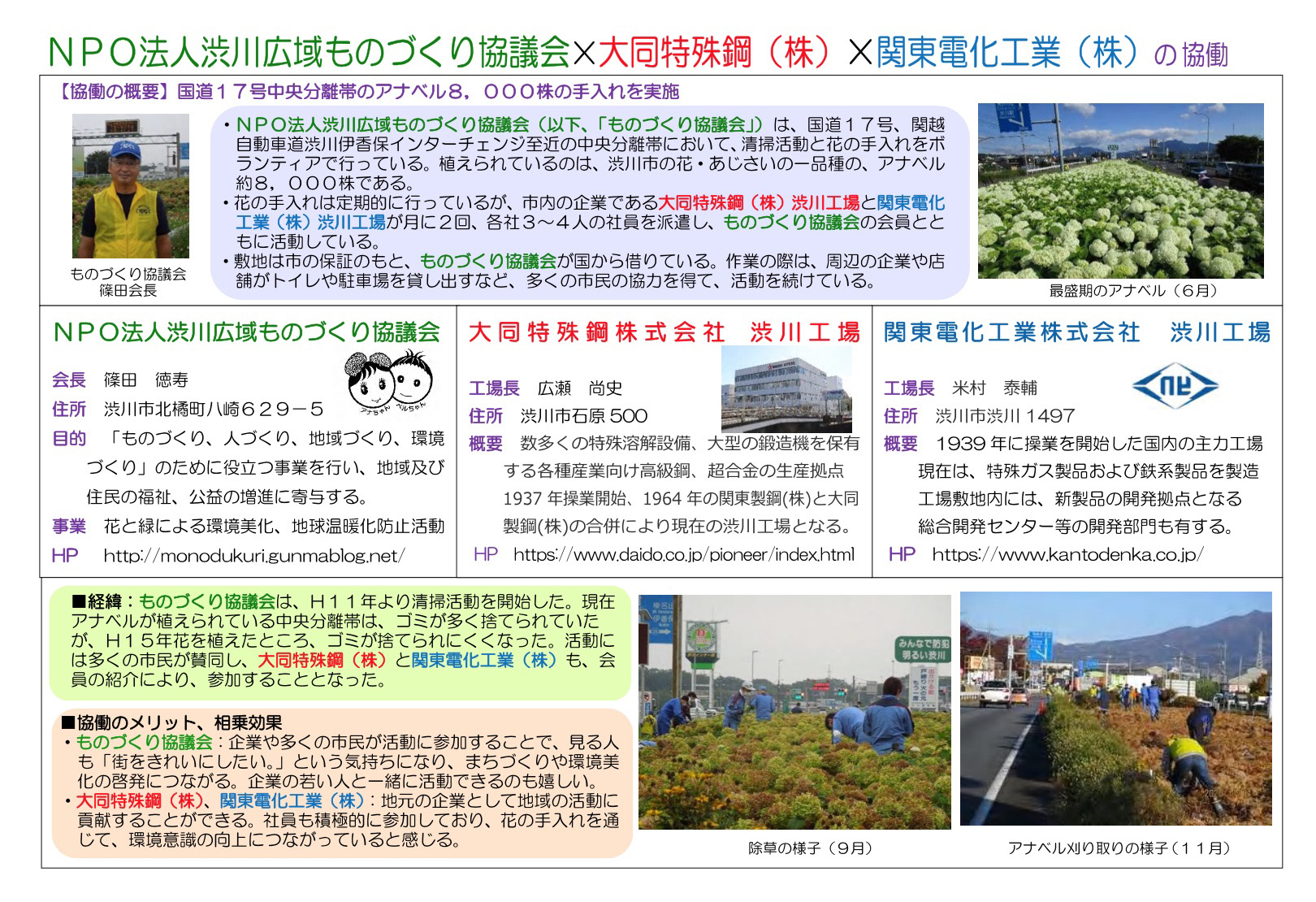
Shibukawa Plant participates in the activities of the NPO Shibukawa Regional Manufacturing Council, which works to beautify the local environment and prevent global warming by growing flowers and greenery such as hydrangeas, the flower of Shibukawa City.
In FY2024, a total of 29 people participated in environmental beautification activities for seven days. In addition, through participation in the conservation activities and tree-planting events held twice a year in the local forest adjacent to Onoike Ajisai Park and donation to Oze Preservation Foundation and a fishing cooperative, we support efforts to conserve local biodiversity. Mizushima Plant participates in local biodiversity conservation efforts through tree-planting events and other activities within Okayama Prefecture.
The activities of the NPO Shibukawa Regional Manufacturing Council were introduced on the website of Gunma Prefecture.