Basic Stance on Corporate Governance
Our management philosophy is “Through the quest for constant corporate growth and acquisition of optimum profits, Kanto Denka Kogyo is working with all its shareholders, users and employees to create a successful company and sustainable society in harmony with the global environment. To achieve this end, we are endeavoring to meet the requirements of our users with our unique technologies and customer-oriented services, and to build a trusted company based on our motto, ‘sincerity, creativity, prompt response and harmony with nature.’”
In other words, our corporate goal is to “contribute to the creation of a sustainable society while enhancing corporate value,” and to achieve this goal, we are working to build good relationships with our stakeholders, including shareholders, local communities, users, and employees, and are committed to improving our corporate governance.
Outline of the Corporate Governance System
Corporate Governance System Diagram
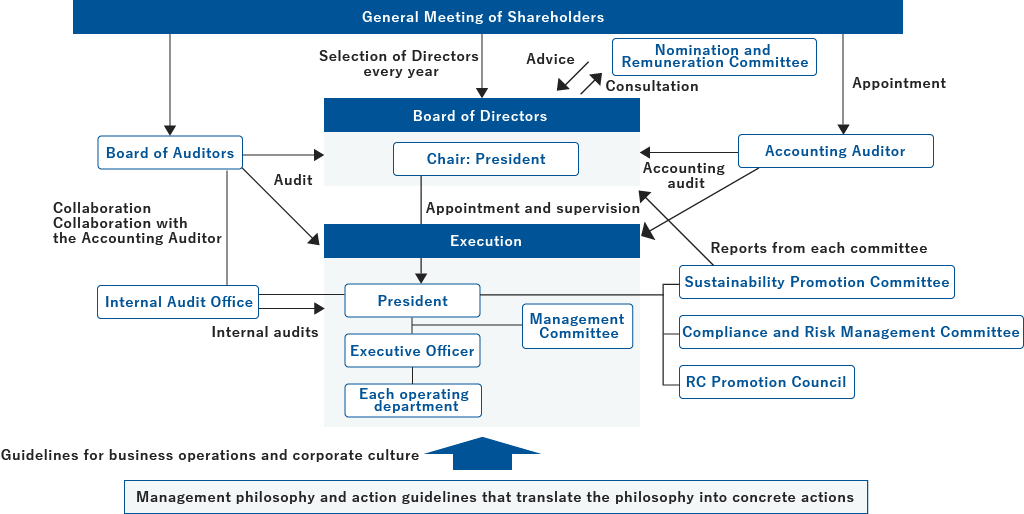
Details of the Company’s Organizations
The Company holds a regular meeting of the Board of Directors once a month to make decisions on important matters and supervise the execution of duties by Directors. In order to further strengthen the functions of the Board of Directors and improve management efficiency, the Management Committee, which is attended by the Directors and Executive Officers who execute the Company’s business, meets once a month to flexibly make decisions on basic and important matters related to business execution.
The Compliance and Risk Management Committee, chaired by the President and with the participation of outside attorneys, has been established as an organization to oversee overall compliance. Each Group company has appointed a compliance promotion officer to ensure collaboration. In addition, the Kanto Denka Kogyo Group Compliance Manual has been formulated as a code of conduct for officers and employees, and all officers and employees are thoroughly familiarized with it, and a consultation and reporting system for compliance has been established. In addition, the Committee oversees antitrust laws, export trade control, and information security through its respective subordinate organizations.
As for internal audits, the RC Promotion Council, chaired by the President, conducts audits in the areas of safety and health, environment, quality, product safety, and logistics through its subordinate organizations, while the Internal Auditing Department conducts internal audits of overall operations.
Status of Auditors and Audits by Auditors
The Company has adopted a company with auditors system consisting of four Auditors, two of whom are Outside Auditors.
The Board of Auditors consists of four members: two full-time Auditors (one of whom has expertise in finance and accounting) and two part-time Auditors, and regularly reports and discusses important matters related to auditing. In order to ensure the effectiveness of audits, full-time Corporate Auditors attend the Management Committee and other important meetings to ensure a system for auditing the execution of duties by Directors.
In addition, the Auditors receive explanations on the contents of accounting audits from the Internal Audit Office and other internal audit departments as well as Ernst & Young ShinNihon LLC, the Company’s accounting auditor, and cooperate with them by exchanging information.
Status of Accounting Audits
The Company has entered into an audit contract with Ernst & Young ShinNihon LLC in accordance with the Companies Act and the Financial Instruments and Exchange Act.
Internal Reporting and Whistleblowing System
Officers and employees are obliged to report any violations of compliance within the Company. The parties reported to are the General Manager of the Legal & General Affairs Department, the General Manager of the Human Resources Department, the General Manager of Administration Department of each plant, the officer in charge of the Legal & General Affairs Department, the officer in charge of the Human Resources Department, the full-time Audit & Supervisory Board members, and the legal counsel. The Company will keep the details of reports confidential and will not treat whistleblowers disadvantageously. The same system will be used to respond when a report is received from an external party such as a business partner. For inquiries regarding external whistleblowing, please visit the “CONTACT” page on our website.
Implementation Status of Corporate Governance Measures
Policy and Procedure for Appointing and Dismissing Upper Management and Designating Candidates for Directors and Auditors by the Board of Directors
The Company elects Directors and Auditors from a diverse range of individuals who possess outstanding character, insight, and a wealth of experience. In terms of selection procedures, the Nomination and Remuneration Committee, of which the majority of members are independent Outside Directors (chaired by an independent Outside Director), is consulted with on the selection of candidates for Directors, and then the Board of Directors will make a decision. Candidates for Auditors will be decided by the Board of Directors after obtaining the consent of the Board of Auditors for the appointment proposal. In addition, in cases where serious misconduct has occurred and the involvement of such misconduct is recognized, or in cases where the Company is unable to achieve its performance targets over a long period of time, the Company will not reappoint senior management.
Independence Judgment Standards for Independent Outside Directors and the Qualities of Independent Outside Directors
The Company selects candidates for Outside Directors who are Independent Directors in accordance with the independence standards established by the Tokyo Stock Exchange. The five Independent Outside Directors are involved in corporate management, corporate legal affairs, corporate accounting, research and development and financial and capital markets, and play an important role in the decision-making process of the Board of Directors by applying their experience and broad insight to management and expressing their opinions from a professional perspective.
Analysis and Evaluation of Overall Effectiveness of the Board of Directors
With regard to the effectiveness of the Board of Directors in FY2024, we conducted self-evaluations and analyses using the following methods with the help of external organizations.
From January to February 2025, we conducted a questionnaire survey of all Directors and Audit & Supervisory Board members who are members of the Board of Directors. We have ensured anonymity by having them respond directly to external parties. The following is a summary of the results.
Based on the responses to the questionnaire, the number of items for deliberation by the Board of Directors and the time required for deliberation were generally positive, and we recognize that the effectiveness of the Board of Directors as a whole is ensured. On the other hand, issues were raised regarding consideration of management that is conscious of capital costs and stock prices, as well as discussion based on the conformity of management strategy with medium- to long-term corporate value creation. Accordingly, we shared challenges for further improving the functions of the Board of Directors.
In the future, based on the evaluation of effectiveness, our Company’s Board of Directors will respond to issues after thorough examination, and continue to promote initiatives to enhance the functions of the Board of Directors.
Policy and Procedure for Deciding on Remuneration for Upper Management and Directors by the Board of Directors
Remuneration for Directors shall be determined by paying attention to the balance between fixed and variable remuneration, as well as between short-term and medium- to long-term remuneration, in order to provide sound incentives for improving business performance and increasing corporate value. Specifically, remuneration for Directors excluding Outside Directors consists of monthly remuneration (fixed portion), bonuses for Directors (performance-linked portion, short-term remuneration), and stock-based remuneration (medium- to long-term remuneration), while remuneration for Outside Directors consists of monthly remuneration only. Procedures for determining the remuneration of Directors are determined by the Board of Directors after consulting the Nomination and Remuneration Committee, of which the majority of members are Independent Outside Directors (chaired by an independent Outside Director).
Also, we have introduced a performance-linked remuneration system and a stock delivery trust for the Directors (excluding Outside Directors). This aims to further clarify the link between the compensation and our stock value so that the Directors can share the risks and benefits of stock price fluctuations with shareholders, thereby increasing their consciousness to contribute to medium- to long-term performance improvement and greater corporate value. Specifically, officer bonuses are determined by multiplying the consolidated ordinary income for the relevant fiscal year (capped at 20 billion yen) by a fixed percentage established for each position, with the final amount adjusted based on the total shareholder return (TSR) indicator. Furthermore, if the consolidated ordinary income for the relevant fiscal year is less than 2 billion yen or if there is a net loss (consolidated or individual), no officer bonuses will be paid.
Cross-Shareholdings
We may acquire and hold shares of our business partners when deemed necessary for maintaining and strengthening stable and long-term business relationships with them.
The acquisition and reduction of the shares of business partners are determined by management decisions based on discussions among the officers in charge and related departments, taking into consideration their relationship with us.
Regarding cross-shareholdings, we comprehensively examine whether it is appropriate to hold shares in light of the purpose of holding them, the benefits and risks associated with holding them, and regularly report to the Board of Directors.
Regarding the exercise of voting rights for cross-shareholdings, our Company will appropriately exercise voting rights for proposals in accordance with our internal Voting Rights Exercise Standards.
In the 12th Medium-Term Management Plan, which was revised in November 2023, we proposed to reduce cross-shareholdings in order to increase capital efficiency as a measure to increase corporate value. We will gradually reduce approximately 30% of our cross-shareholdings held as of the end of March 2023 by FY2026, and use the proceeds from the sale for business activities.
Policies and Procedures for Constructive Dialogue with Shareholders and Investors
With regard to dialogue with shareholders and investors at our Company, the Public Relations & Investor Relations Department, under the officer in charge of investor relations, exclusively oversees actual operations, and investor relations is handled after consultation with the President, each officer, and related departments. In FY2024, we accommodated approximately 170 individual interviews from analysts and institutional investors.
We hold financial results briefings for investors at the time of annual and interim financial statements. In addition, it has been held online since the interim period of the fiscal year ending March 2025. Financial results briefing materials are promptly disclosed on our website.
Information obtained through dialogue with shareholders and investors is fed back to management and the Board of Directors on a regular basis.
We manage insider information in accordance with rules on internal information management and regulations on insider trading. Also, the period before the financial results announcement is considered a silent period, during which we restrict dialogue and interviews with investors.