Disclosures based on the TCFD’s Recommendations
In May 2022, the Group stated its support for the recommendations of the Task Force on Climate-related Financial Disclosures(TCFD) as well as conducted a scenario analysis following these recommendations and examined countermeasures. The Group will now disclose information on its initiatives to address climate change, along with contributing to more resilient management and the realization of a sustainable international community.
The Group has been striving to preserve the global environment through the development of environmentally friendly products and the reduction of greenhouse gas emissions. In our 12th Medium-Term Management Plan, we aim to be a creative development-driven company that contributes to a sustainable society by supporting the world’s leading technologies with unique and superior products.

Governance
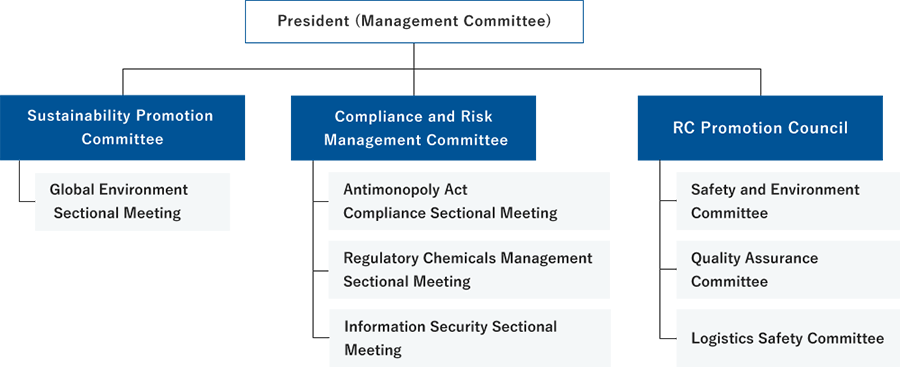
The Group has placed sustainability at the core of its management policy, including its response to climate change, and has established the Sustainability Promotion Committee, chaired by the President, to promote sustainability. In regard to the important theme of climate change issues, we established the Global Environment Sectional Meeting under the Sustainability Promotion Committee to handle our response to climate change, including the reduction of greenhouse gas emissions. Climate change related information is managed by the Sustainability Promotion Committee and Global Environment Sectional Meeting, which deliberate and determine specific targets. Details of these discussions are reported regularly to the Board of Directors (targeting at least twice a year) and, among them, matters approved by the Board of Directors are reflected in the Medium-Term Management Plan and annual plan. Additionally, the status of our response to climate change is monitored and managed by the Sustainability Promotion Committee, ensuring the progress is supervised continuously.
Strategy
The Group identifies risks and opportunities of climate change and evaluates the impacts on its business operations, with Sustainability Promotion Committee and Global Environment Sectional Meeting spearheading these efforts. In the evaluation of risks and opportunities, we conduct scenario analysis using multiple scenarios published by the International Energy Agency (IEA) and Intergovernmental Panel on Climate Change (IPCC). Going forward, we will use analysis to explore impacts in 2030 assuming the following two world views.
| 2°C (1.5°C) Scenario | |
|---|---|
| This scenario assumes that the impacts of policies and regulations will grow, resulting in more proactive efforts toward the transition to a decarbonized society so that the increase in average temperature will be limited to less than 2°C by 2100 compared to the Industrial Revolution. | (Referenced scenarios) Fifth Assessment Report of the IPCC (AR5) RCP2.6 IEA WEO2021 SDS, NZE2050 |
| 4°C Scenario | |
| This scenario assumes that governments’ climate change countermeasures will not go beyond current policies and regulations, and that the average temperature will rise by about 4°C in 2100 compared to the Industrial Revolution, resulting in greater physical impacts such as abnormal weather disasters. | (Referenced scenarios) Fifth Assessment Report of the IPCC (AR5) RCP8.5 IEA WEO2021 STEPS |
2°C (1.5°C) Scenario Analysis
In the 2°C (1.5°C) scenario analysis, a variety of policies and regulations are expected to be introduced for the transition to a decarbonized society, and the Group recognizes that there are risks, including the financial impact of carbon taxes and reduced sales of our products due to diminished demand for products with a high global warming potential.
On the other hand, due to growing awareness of climate change, the market for lithium-ion batteries, which are indispensable for electric vehicles that will play a part in realizing a decarbonized society, is expected to expand, and as a result, demand for materials required to make lithium-ion batteries supplied by our company will also increase. We believe that this can be a great opportunity. Going forward, we will evaluate these risks and opportunities, both quantitatively and qualitatively, and examine countermeasures.
| Factors | Time horizon | Events | Classification | Response measures |
|---|---|---|---|---|
| Carbon pricing | Long-term | Increased costs related to business operations due to the introduction of carbon pricing, including carbon taxes | Risk |
|
| Changes in energy costs | Medium to Long-term | Increased costs for purchasing electricity associated with the transition to renewable energy | Risk |
|
| Increased transportation costs due to soaring fossil fuel prices | Risk |
|
||
| Changes in demand for environmentally friendly products | Medium to Long-term | Decreased demand for high GWP products | Risk |
|
| Growth of lithium-ion battery market | Opportunity |
|
||
| Increased demand for environmentally friendly products including low GWP gas products, etc. | Opportunity |
|
||
| Changes in raw materials costs | Medium to Long-term | Rising procurement costs caused by complex factors | Risk |
|
| Definition of time horizons Short-term: Less than 3 years; Medium-term: 3 years or more to less than 5 years; Long-term: 5 years or more |
||||
4°C Scenario Analysis
In the 4°C scenario analysis, extreme weather is expected to become more frequent and devastating, and the Group recognizes that possible flood damage at its domestic bases poses the greatest risk. In addition, damages incurred from the suspension of operations of our bases caused by flooding is also a risk. Going forward, we will evaluate these risks, both quantitatively and qualitatively, and examine countermeasures.
| Factors | Time horizon | Events | Classification | Response measures |
|---|---|---|---|---|
| Severity of extreme weather events | Short-term | Direct damages to the Company’s bases caused by flooding or tidal surge | Risk |
|
| Direct damages to the Company’s bases caused by flooding or tidal surge (Damages caused by suspension of operations due to damaged bases) |
||||
| Drought | Long-term | Further shortage of semiconductors resulting from droughts, leading to reduced sales opportunities of specialty gases and diminished sales | Risk |
|
| If the Shibukawa Plant consumes large amounts of industrial water, a water shortage could affect production activities, leading to diminished sales on reduced production capacity |
|
|||
| Definition of time horizons Short-term: Less than 3 years; Medium-term: 3 years or more to less than 5 years; Long-term: 5 years or more |
||||
Risk Management
In its response to climate change, the Group, through the Sustainability Promotion Committee and Global Environment Sectional Meeting, evaluates risks and opportunities using scenario analysis and other methods after identifying expected climate change risks. In addition, we will address risks related to climate change countermeasures, such as energy conservation measures, and other important ESG issues through close collaboration with other committees as necessary. The Compliance and Risk Management Committee is responsible for labor environment and governance, while the RC Promotion Council is in charge of quality assurance, reduction of waste, and energy conservation measures. In this manner, we conduct risk management by continuously collecting information. Details of these deliberations are regularly reported to the Board of Directors and discussed countermeasures are reflected in business activities to improve risk management.
Sustainability Policy and Structure Corporate Governance System
Indicators and Targets
Initiatives for Carbon Neutrality
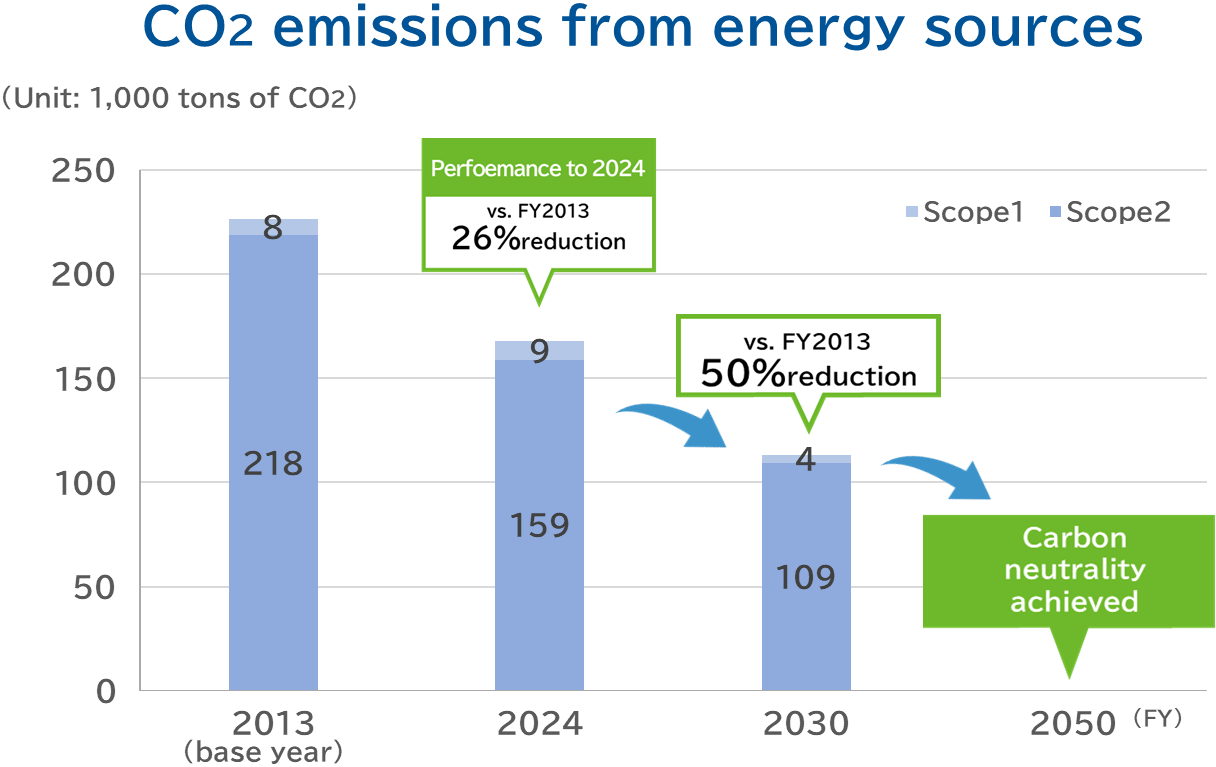
- Reduce greenhouse gas emissions from energy sources (Scope 1 and Scope 2 from energy sources) by 50% by FY2030 as compared to FY2013
- Achieve carbon neutrality (virtually zero greenhouse gas emissions) by FY2050
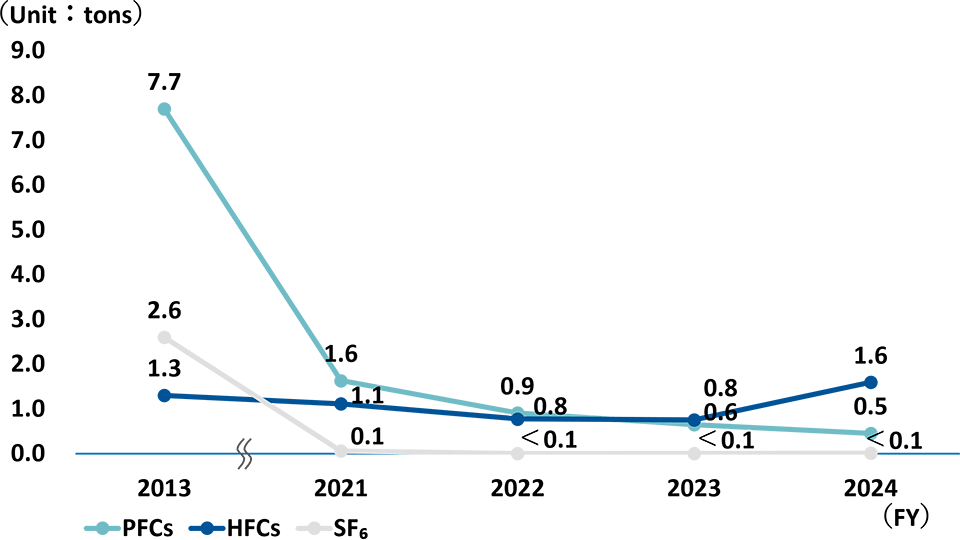
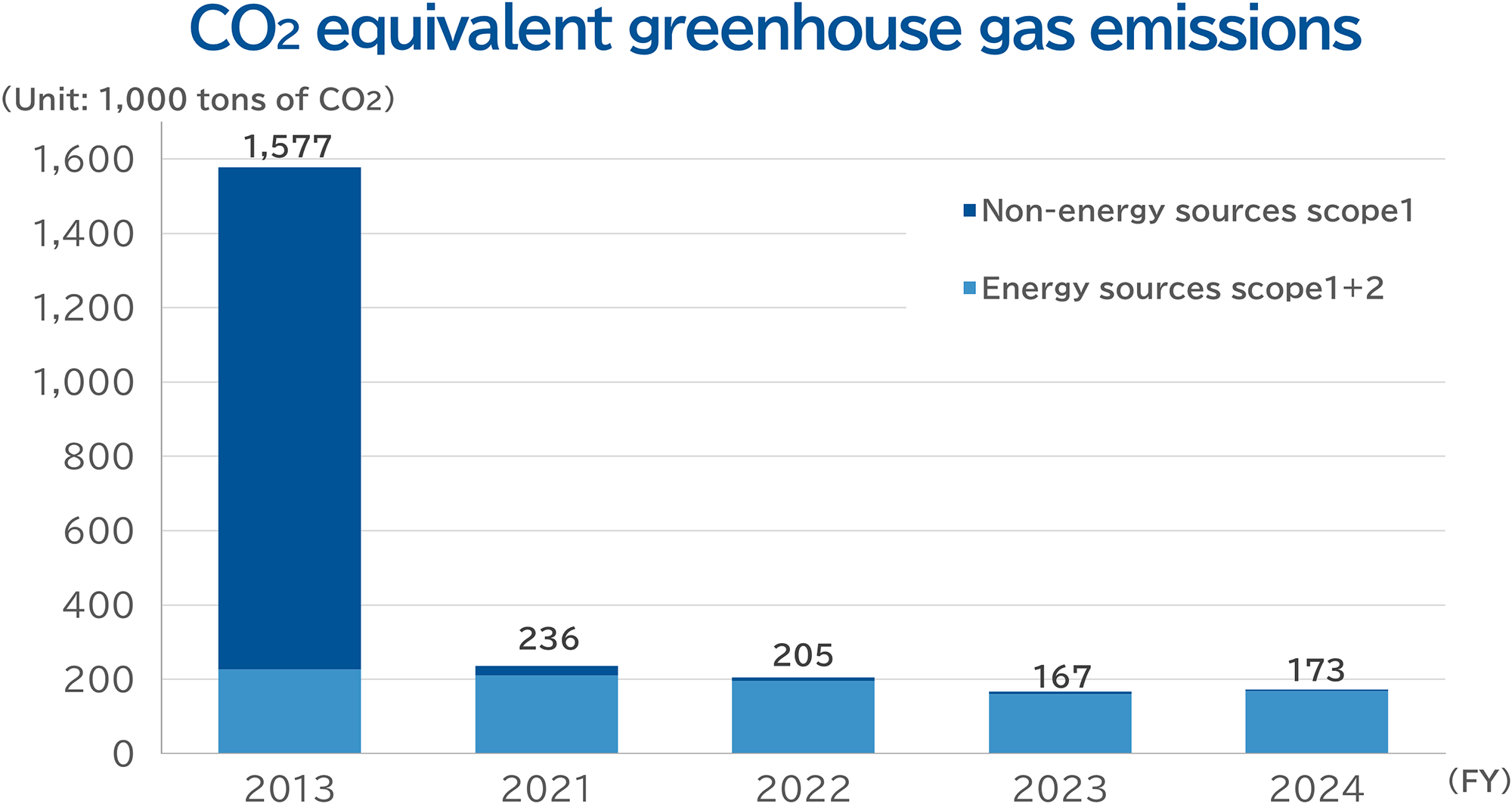
As a climate change countermeasure, we have introduced pollution abatement equipment since 2009 while working to reduce greenhouse gas emissions from non-energy sources, and have achieved significant results.
We have been promoting sustainability activities, reducing energy-intensive products, and strengthening our commitment to decarbonization and recycling as one of the key strategies of our 12th Medium-Term Management Plan Dominate 1000 since FY2022 to enhance social value.
In order to contribute to the creation of a sustainable society, we have set a new long-term target to reduce our energy-derived greenhouse gas emissions (Scope 1 and 2) in 2030 by 50% compared to 2013, and we will accelerate the reduction of greenhouse gas emissions with the aim of achieving carbon neutrality by 2050.
Vision toward 2030 and Policies for Main Initiatives and Policies
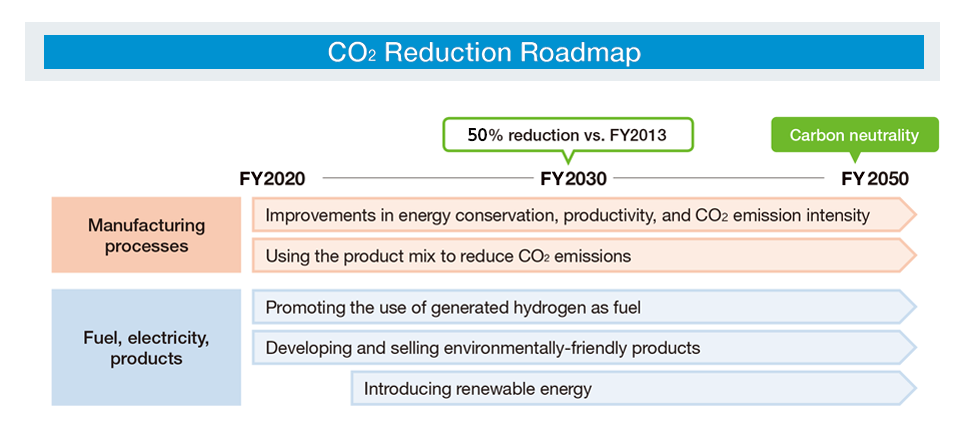
Our vision is to accelerate the expansion of precision chemicals by further advancing fine chemicals, promote the development of technology for greenhouse gas emission reduction and decarbonization, and become a creative development-driven company that contributes to a sustainable society. Toward this end, we are carrying out the following as policies for main initiatives.
- Improve CO2 emission intensity while achieving growth in the fine chemicals business
- Introduction of renewable energy
- Product mix (in addition to productivity improvement and portfolio restructuring)
- Promote the development of environmentally friendly products
![Reduction Target | [FY2030] 50% reduction compared to FY2013 | [FY2050] Targeting carbon neutrality (virtually zero emissions)](/assets_lang/english/img/sustainability/environment/vision_02.png)
Initiatives
Reducing Greenhouse Gas Emissions
Non-energy-derived emissions (Scope 1)
When we first started our RC activities, there were several products with high global warming potential (GWP) in the conventional specialty gases line, and the greenhouse gases emitted from the process associated with the manufacture of these products accounted for the majority of our Scope 1 non-energy source greenhouse gas emissions. To reduce non-energy-derived greenhouse gas emissions, in addition to control of emissions from manufacturing processes, we started installing abatement equipment in 2009, significantly reducing greenhouse gases (PFCs, HFCs, SF₆, NF₃) emitted from manufacturing processes. In FY2024, we achieved a 99.6% reduction (CO2 equivalent) compared to FY2013, or 79.4% compared to FY 2021.

Energy-derived emissions (Scope 1 + Scope 2)
We produce various compounds from fluorine and chlorine obtained through electrolysis, which consumes a large amount of electricity.
Despite our efforts to reduce energy consumption through energy conservation and process improvements, our energy consumption has increased due to the expansion of production capacity, and energy-derived greenhouse gas emissions have been leveling out.
In order for us to grow into an “innovative, development-driven company” that contributes to a sustainable society, and to aim to achieve carbon neutrality by 2050, we have set an interim goal of reducing energy-derived greenhouse gas emissions by 50% by FY2030 compared to FY2013.
In FY2024, the emissions reduced by 26.0% (CO2 equivalent) compared to FY2013, or 20.3% compared to FY2021.
The 9th RC Action Targets
- Target: Reduce CO2 equivalent greenhouse gas emissions by 20% compared to FY2021 levels (4% reduction per year).
- Result: 26.7% reduction in FY2024 compared to FY2021(89.0% reduction compared to FY2013)
Introduction of Solar Power Generation Equipment
In FY2023, we installed solar power generation equipment at our Shibukawa and Mizushima Plants. We will further accelerate the reduction of greenhouse gas emissions by creating and using renewable energy while promoting energy conservation and improvements of energy per unit, and aim to achieve carbon neutrality by 2050.
Effective Use of Hydrogen
In our efforts for energy conservation and reduction of greenhouse gas emissions associated with fuel use, we work on effective use of surplus hydrogen generated from the production process as fuel.
Entire Supply Chain (Scope 3)
We calculate the greenhouse gas emissions throughout the supply chain from raw material purchases to customer use and disposal (Scope 3) and work on reducing greenhouse gas emissions across the entire supply chain.
Improvement of Energy Consumption per Unit of Production
We continue to implement proactive activities such as improving power-hungry facilities and reducing steam intensity.
With the revision of the Act on the Rational Use of Energy in FY2023, we have reviewed our targets.
In FY2024, Shibukawa Plant achieved its target, while Mizushima Plant fell short of its target.
Act on Rationalization of Energy Use and Shift to Non-fossil Energy
The 9th RC Action Targets
- Target: Reduce energy consumption (crude oil equivalent) per factory production volume by 3% compared to FY2023 (1% reduction per year).
- Result: While Shibukawa Plant reduced its energy consumption per production volume by 1.6%, consumption at Mizushima Plant increased by 10.8% in FY2024 compared to FY2023.
Third-party Verification and Assurance
We started third-party verification in FY2023 to assure stakeholders of the reliability of the information contained on this website, in the Integrated Report, and other media.